CSA Member Handbook
Everything you need as a Martenette Farms CSA member: how ordering works, delivery and pickup times, our policies, and tips for storing and cooking your vegetables.

About the Farm
Martenette Farms is a small, certified organic vegetable farm on Amwell Road in Hillsborough, New Jersey, run by farmers Andrea and Tony Kennette. The farm is about 7 acres: 1.5 acres in annual vegetables, 3.5 acres in pasture and a young fruit orchard, and 2 acres of woods we're cleaning up to replant.
We grow mostly by hand, with a walk-behind tractor, a human-powered transplanter and hand tools. We focus on building biodiversity: cover crops for the soil, native herbs, shrubs and trees in the woods, and more fruit trees, berries and perennials every year.
Read more about how we grow and meet the whole crew on our About page.
Membership Perks
Your share is a prepaid balance with bonus credit on top. Here's what comes with it:
- Bonus credit: pay $210 for $225, $297 for $330, or $351 for $405 in credit.
- Your pick every week: choose exactly the vegetables you want from what's ready.
- Low order minimum: orders start at $15, so order a little or a lot.
- Free delivery or pickup: home delivery within 12 miles of the farm or 5 miles of Ocean Grove, or Friday pickup in Asbury Park.
- Your schedule: order weekly or every other week.
Weekly Ordering
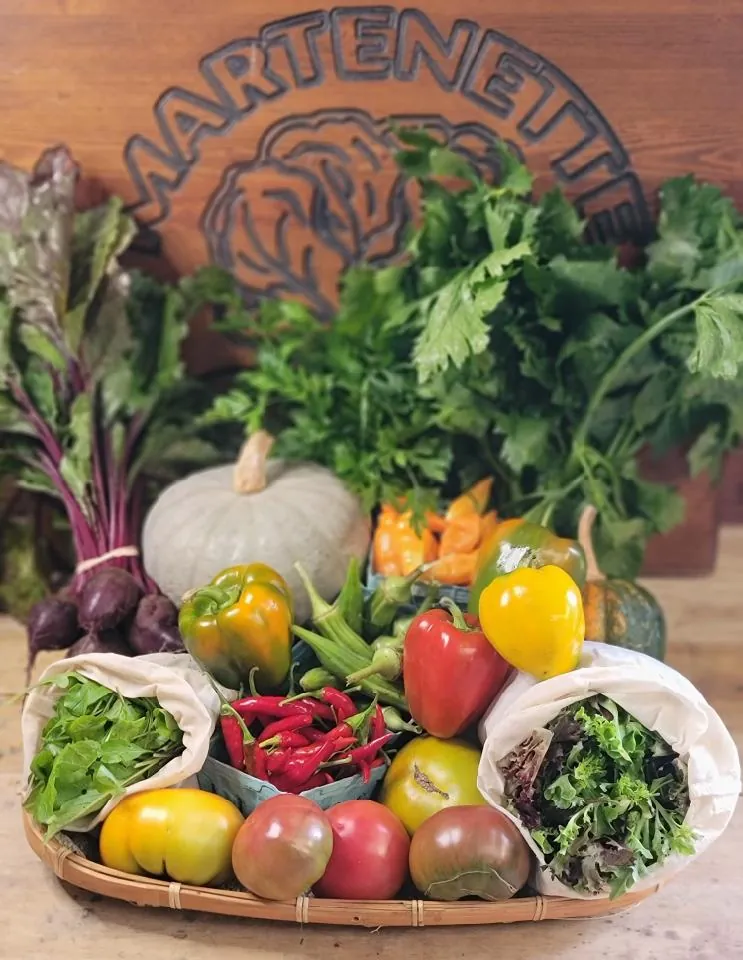
Each week, log in to your Farmhand account and pick the vegetables you want from what's ready. Orders start at $15, and the cost comes out of your CSA balance. Order by 9pm Monday for Tuesday delivery, 9pm Friday for Sunday delivery, or 9pm Wednesday for Friday Beach Town delivery or Asbury Park pickup.
If you don't pick anything by the cutoff, nothing is sent and nothing comes out of your balance.
Pickup & Delivery
We deliver three days a week and have one pickup spot. Delivery and pickup are both free.
- Tuesday home delivery, 4–9pm: within 12 miles of the farm in Hillsborough. Order by 9pm Monday.
- Sunday home delivery, 1–5pm: within 12 miles of the farm. Order by 9pm Friday.
- Friday Beach Town delivery, 1–6pm: within 5 miles of Ocean Grove. Order by 9pm Wednesday.
- Friday pickup, 1–6pm: Flying Pig Market, 527 Bangs Ave Unit 1, Asbury Park. Order by 9pm Wednesday.
Not sure if you're in a delivery zone? See the map on our CSA page, or enter your address at signup to see which days you get.
Heading out of town? Just skip ordering that week. If you don't pick anything by your cutoff, nothing is sent and nothing comes out of your balance.
FAQ & Policies
CSA stands for Community Supported Agriculture. When you buy a share before the season, you help us pay for seeds, soil and equipment up front. In return, you get bonus credit to spend on our vegetables all season.
Everything is grown on our certified organic farm on Amwell Road in Hillsborough, NJ. Most of our mushrooms are grown from certified organic blocks made by our partner, Noble Mushrooms. We also grow wine cap and shiitake mushrooms from organic spawn, but those aren't certified organic.
Yes. You pick every item in your order from what's ready that week, and the cost comes out of your CSA balance. What's available changes with the season, so check back each week.
Yes, for any reason, up until August 1 of the season you bought your share. Email martenettefarms@gmail.com and we’ll check your balance. We’ll subtract the member bonus you got at the start of the season and refund the rest within 2 weeks by credit card, Venmo, PayPal or check. Refunds aren’t available after August 1.
Here’s an example. Say you buy a $210 share. With your $15 member bonus, your starting balance is $225. You spend $150 in June and July, which leaves $75. If you move out of state and cancel, you’d get $60 back: your $75 balance minus the $15 bonus.
It's up to you, as long as your order is at least $15. Some members order a few items, and others fill a big box. Your balance only goes down by what you order.
Farmhand How-Tos
Member Tips & Resources
Kitchen Tools & Gadgets
Level up from CSA Member to CSA Master with tools and gadgets handpicked to help you maximize the enjoyment of your farm box.
- Salad spinner: Washes and dries greens fast, so they stay crisp longer.
- Good kitchen knives: Plus a knife sharpener, or a local business that sharpens knives.
- Reusable glass containers and mason jars: Keep your food as farm-fresh as possible.
- Sheet pans: For roasting delicious veggies.
- Food processor: The one “big-ticket” item we recommend. Use it for salsa, pesto and pizza dough, and for pureeing soups and sauces.
Keeping Your Produce Fresh
Alliums
- Bunched (spring garlic, scallions, spring onions): Store in a plastic bag or damp cloth in the fridge. Without a bag they'll wilt, but they're still usable.
- Fresh onions and garlic: Store in the fridge. No bag needed, and expect a couple of weeks of freshness.
- Cured garlic and onions: Store on the countertop or in a cool, dark drawer. Just like anything else in a root drawer, though, don't forget about them!
Eggs
Our eggs are washed and refrigerated, and they should be stored in the fridge. We do this because our barn temperature fluctuates, and it's safer from a food safety perspective to keep them at a consistent temperature.
Flowers
We provide flower food packets. I recommend using half on day one and the other half on day three. Change the water every day and snip the bottoms of the stems to keep them fresh. Pull off any leaves that would touch the water.
Greens
- Loose bunched greens (napa, cabbage, kale, collards, chard, bok choy, broccoli rabe, lettuce heads, celery): These are dunked and hydrocooled for about 30 minutes after harvest, then chilled in the fridge. Unless you request it, we deliver them without plastic, but they'll stay crisp and fresh if you protect them in your fridge. If you use plastic, put the bunch in a bag in the fridge. To avoid plastic, wrap the bunch in a damp cloth towel. If you'd like us to provide a plastic bag, write a note on your order.
- Bagged greens (baby greens, lettuce mix, baby bok choy): These are soaked and hydrocooled for 30 minutes to an hour, then spun, chilled and bagged. We use our house well water, but they aren't technically "washed." Only facilities inspected by third-party safety auditors can call their produce washed, and that's an expensive process, so we say we hydrocool. Hydrocooling extends the produce's shelf life after harvest. Storage is simple: the bag as-is will keep in the fridge for at least a week. If there's extra moisture in the bag, re-spin the greens or add a paper towel. You can also take the greens out and store them in a damp cloth bag.
Herbs
- Leafy cool-season annuals (cilantro, dill, parsley): We deliver these without a bag after hydrocooling. They store well in a bag in the fridge. A note on cilantro: it needs to be dry before it goes in a bag, otherwise it turns to black mush.
- Basil, lemon balm and mint: Basil does NOT like being cold or damp, and neither does lemon balm. Mint is more tolerant. To store, cut the bottoms of the stems and stand them in cool water on your counter. Any leaves that touch the water will turn black, so remove those and use them first. Change the water once or twice a day.
- Perennial herbs (oregano, thyme, anise hyssop, sage, rosemary, lavender): If they're dry, they can go in a plastic bag in the fridge. They can also be stored like basil.
Morganics
Morganics products are freshly milled and still have all their healthy oils intact. They're best stored in the fridge or freezer.
Mushrooms
Store mushrooms in the fridge in the paper bags they're delivered in. Shiitake, lion's mane and black pearl last the longest, then blue, then yellow and chestnut, then pink. Cook pinks within 3 days.
Roots
- Fresh with greens (radishes, beets, salad turnips, purple turnips, kohlrabi, carrots, fennel, celeriac): First, separate the greens from the roots. If the greens stay on, they pull moisture from the root and the root goes floppy. (Kohlrabi and fennel aren't technically roots, but they store the same way.) If you're using the greens, store them separately like the bunched greens above. Keep the roots in the fridge in a plastic bag, a damp cloth or, what I do, a glass or plastic container. They'll stay crisp for a month.
- Storage roots without greens (radishes, beets, turnips, kohlrabi, carrots, fennel, celeriac and rutabaga): Store them in the fridge the same way as fresh roots, in a plastic bag, a damp cloth or a container. With no greens pulling moisture out, they keep even longer.
- Potatoes: We don't offer storage potatoes, only fresh, but I ate our last October potatoes in March! Our potatoes are sold washed and will keep in a paper bag in the fridge for a month or two (or five).
Summer lovers
- Zucchini, eggplant, cucumbers, peppers and okra: If part of your fridge can be set to 55°F, store them there. Otherwise, use the crisper drawer. They'll last longer in a bag (paper or plastic) or a cloth. Eggplant gets brown and soft spots if it's too cold, but it can still be safely cooked. Cucumbers and zucchini also get soft and spotty if they're too cold or too warm. Peppers are more forgiving.
- Tomatoes: When you receive your tomatoes, leave them on your kitchen counter, bottoms up, to ripen. If they're near your fruit bowl, especially near bananas or onions, they'll ripen faster, though that can cause some spoilage. Check your tomatoes for damage. Splits are usually okay if they're clean, dry and not oozing. If a tomato is oozing or moldy, you can usually cut that part away and still enjoy it fresh. Otherwise, put it in the fridge to cook with later. Refrigerating tomatoes turns their texture mealy and dulls the flavor. Tomatoes are ripe when they're an even color (except for green shoulders or multicolored varieties) and have a slight give. A serrated knife is best for cutting tomatoes or, if you're feeling fancy, a Cutco trimmer or cheese knife.
Winter squash and sweet potatoes
Store these on the countertop. If they get soft, cut away the bad parts and use the good stuff.
Tomatoes
There are thousands of tomato varieties in existence. From the Great White (heirloom) to the Rutgers beefsteak (hybrid) to the Flavr Savr (GMO), tomatoes are bred for flavor, disease resistance, shelf stability, resistance to cracking, looks and more. As a certified organic farm, we don't grow any GMO tomatoes. We rely on heirloom and hybrid varieties, and we weigh disease resistance, flavor and looks most heavily when choosing what to grow. Our tomatoes fall into two groups, house tomatoes and field tomatoes, and each has its own advantages, disadvantages and needs.
House (high tunnel) tomatoes
These tomatoes are started from seed in late February or early March and transplanted into an unheated high tunnel. Growing in a high tunnel has a lot of benefits:
- The warmer temperatures inside allow for earlier planting and extend the season past the first frost.
- The tunnel's roof reduces the damage from rain, which spreads fungal disease.
- Tunnel tomatoes are grown on a string trellis. Weekly pruning and training let us control airflow and the number of fruits per set, and give us a chance to check the plants' health regularly.
We plant about 320 tomatoes in 90-foot beds. We've always used double-leader pruning, which leaves two main vines, with all the leaf-node suckers pruned off each one. The two vines are clipped to a string attached to the tunnel's cross bars, and the leaves are pruned to just above the fruit sets. This year we're experimenting with a single leader to allow more airflow.
The varieties that do well in the tunnels are heirlooms, heirloom-looking hybrids and some hybrid cherry tomatoes. All of these are indeterminate, meaning they keep producing fruit all season and ripen as they go. Heirlooms, grown for their unique looks and exceptional flavor, are notoriously prone to disease and need great care to avoid bruising and cracking. Heirloom-looking hybrids keep the unique looks and much of the flavor of heirlooms but are less vulnerable to disease and have thicker skin, so they handle swings in water and heat better. The house tomato harvest starts in late June and runs through October, as long as the plants stay healthy.
Field tomatoes
The field can be unforgiving. Between unexpected frosts, excess rain, heat, humidity and dry spells, field tomatoes need to handle it all while staying delicious, mostly blemish-free and resistant to the bacterial and fungal infections in the air and soil. That usually means we stick to a few trusted slicing varieties that look more like grocery store tomatoes. These tend to be determinate, meaning they set all their fruit over about seven weeks and ripen it over about three weeks, followed by a second, usually smaller, flush. Our field varieties are pink and red beefsteaks, with an heirloom or two thrown in to trial their vigor. Most of our cherry tomatoes are grown in the field too. Cherry tomatoes are indeterminate and produce until late September. Rain can cause cracking, especially in cherry tomatoes, so while we usually harvest field tomatoes about ¾ ripe, we'll pick them at first blush if a storm is coming.
Ripening
Tomatoes usually ripen from the bottom up, so when I check their color, I look at the bottom of the fruit. It gives the best idea of what color the whole tomato will be when it's fully ripe. Ideally, ripening starts at the bottom and works evenly up to the shoulders. As tomatoes ripen, they produce sugars, and as long as the fruit is blushing and kept above 55°F, it will keep making those sugars and ripening. Warmer spots speed up ripening but can also speed up decay, and cooler temperatures slow it down. Temperature, moisture and micronutrients are what get a tomato to ripen perfectly, though they aren't always easy to control.
How we harvest
Everyone has heard that vine-ripened tomatoes have more flavor than ones picked green and "ripened" with ethylene gas. That's true, but we don't need to wait until a tomato is 100% ripe to get 100% of the flavor. Once a tomato starts ripening, it produces its own ethylene to keep the process going, and it keeps doing that after it's picked, ripening over three days to a week. Tomatoes tend to bruise and crack when they're close to ripe, especially if they're left on the vine. That's why we usually harvest house tomatoes at first blush and let them finish in our ripening room. The end result is a sweet, flavorful tomato with less cracking and bruising. Field tomatoes are picked closer to full ripeness, since once they start ripening in the field it can happen fast. During the three or four weeks of the first field flush, we often harvest 50 to 100 pounds three times a week. Cherry tomatoes are picked close to ripe or fully ripe, though we may pick them earlier right before a big rain, since they crack easily.
Imperfections on tomatoes
- Green shoulders: A classic sign of potassium deficiency. We feed potassium through the drip lines once a week to cut down on it, but some plants are more prone to it, and good watering after feeding matters. In the field, the ground has been quite wet, which makes it hard to water after feeding. Green shoulders sometimes fade as the fruit ripens, but not always. That part of the fruit is less tasty, and I usually cut it off when eating a tomato fresh.
- Uneven ripening: Like green shoulders, this is mostly caused by potassium deficiency and uneven watering. Eat the ripe part and compost the rest.
- Splits: Splits happen most often on thin-skinned tomatoes and usually come from uneven watering. In the high tunnel, the ground can get too dry after several hot days, and even a long, slow drink from the drip tape makes the fruit take up water fast and burst its skin. Not every split is the kiss of death. If a tomato splits when it's ripe, it's safe to eat within a few days as long as the split isn't growing mold. If it is, cut the mold out and cook or process the rest. Some splits are skin-deep and don't affect the inside at all. Those are totally fine to eat and aren't prone to mold. A dry split goes through the skin and flesh but breaks between the chambers, so the fruit doesn't spoil.
- Black spots: These usually show up later in the season and are a sign of late blight or other diseases. You can usually cut around them without affecting the taste, especially if you're cooking or processing. We try to sort these tomatoes out, but spots can appear as a tomato ripens.
Varieties
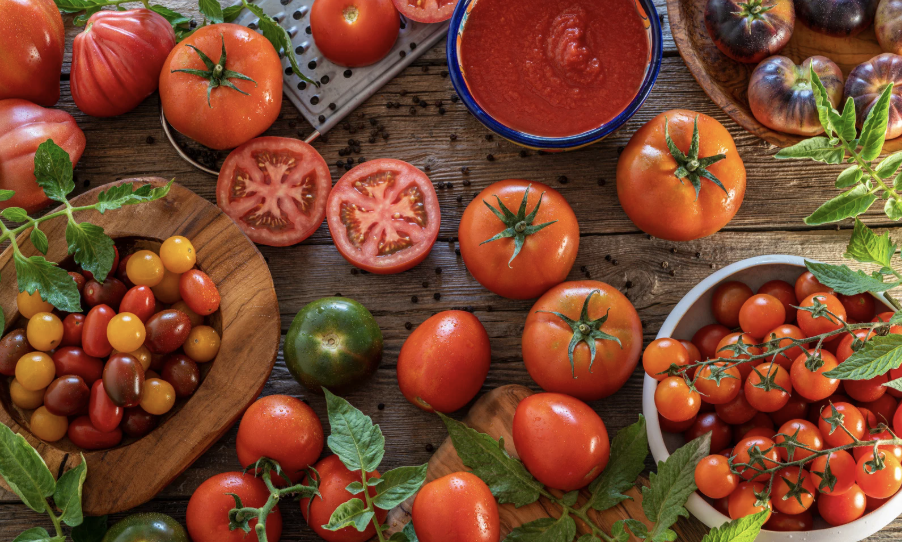
- Yellow (Yellow Brandywine, Copia, Napa Chardonnay Blush, Pork Chop): Low-acid flavor. Moderately resistant to cracking but tends to ripen unevenly.
- Yellow, orange and pink (German Johnson, Gold Medal): Large fruits that are especially prone to cracking. Mild, sweet flavor, juicy and a little sloppy when ripe.
- Orange (Valencia): Actually an heirloom, even though it looks like an ordinary slicer. Superb flavor and shelf life, not prone to cracking or green shoulders, thick-skinned and firm even when ripe.
- Pink (Pink Brandywine, Abigail, Damsel): Tends to ripen irregularly and get green shoulders. Abigail and Damsel (a field variety) are round, thicker-skinned slicers, while Brandywines are odd-shaped and thin-skinned. A very pleasant tomato taste without the metallic taste that can come with store-bought tomatoes.
- Green (Cherokee Green): Deep yellow-green when ripe. Splits easily, but the flavor is tangy and crisp.
- Purple (Black Pineapple, Ananas Noir, Black Brandywine, Carbon, Cherokee Purple): The shoulders on all of these are dark purple or green, and while they fade when ripe, there's usually a little color left. Sometimes prone to splits or dry splits, which don't affect the flavor or shelf life. Rich, sweet flavor.
- Red (Caiman, Galahad, Omar's Lebanese, Moskvich): Robust tomato flavor. Caiman and Galahad are firm beefsteaks. Omar's Lebanese is an heirloom, and so is Moskvich, which is smaller. Galahad is determinate, so it ripens quickly over about three weeks. We also grow a second round of Galahad in the high tunnel, planted in mid-July.
- Paste (San Marzano, San Marzano II, Granadero): Usually harvested fully ripe and used for cooking and processing. They're meaty, with less inner goo than other tomatoes. Paste tomatoes are also prone to black spots and soft spots, so they may need some trimming before processing.
Tomatoes are most productive during the hot days and warm nights of summer. Their productivity and ability to fend off disease wane as the days shorten, and the colder nights of late September affect their size and flavor, but the plants keep producing until the frost kills them (or we do).
For how to ripen and store tomatoes at home, see Keeping Your Produce Fresh above.
Contact Information
Missing something from your order, or have a question about your share? Reach out to the farm. For help logging in or using your account, contact Farmhand.